Woe to you, my Princess, when I come. I will kiss you quite red and feed you till you are plump. And if you are froward, you shall see who is the stronger, a gentle little girl who doesn't eat enough, or a big wild man who has cocaine in his body.
Letter from Sigmund Freud to his fiancee
The sun, the moon and the stars would have disappeared long ago had they happened to be within the reach of predatory human hands." - See more at: http://quotationsbook.com/quotes/tag/ecology/#sthash.Zgz3KQEA.dpuf
The sun, the moon and the stars would have disappeared long ago had they happened to be within the reach of predatory human hands." - See more at: http://quotationsbook.com/quotes/tag/ecology/#sthash.Zgz3KQEA.dpuf
I've often thought that there isn't any "I" at all; that we are simply the means of expression of something else; that when we think we are ourselves, we are simply the victims of a delusion.
Aleister Crowley, Diary of a Drug Fiend
It is not heroin or cocaine that makes one an addict, it is the need to escape from a harsh reality. There are more television addicts, more baseball and football addicts, more movie addicts, and certainly more alcohol addicts in this country than there are narcotics addicts.
Shirley Chisholm
The sun, the moon and the stars would have disappeared long ago... had they happened to be within the reach of predatory human hands.
Havelock Ellis
Extinction is the rule. Survival is the exception.
Carl Sagan, The Varieties of Scientific Experience
The sun, the moon and the stars would have disappeared long ago had they happened to be within the reach of predatory human hands." - See more at: http://quotationsbook.com/quotes/tag/ecology/#sthash.Zgz3KQEA.dpuf
The sun, the moon and the stars would have disappeared long ago had they happened to be within the reach of predatory human hands." - See more at: http://quotationsbook.com/quotes/tag/ecology/#sthash.Zgz3KQEA.dpuf
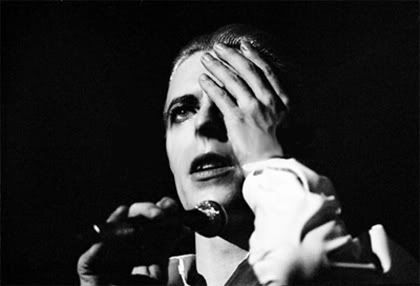
By all accounts, he had to get away from L.A. That much is a matter of undisputed public record. Some claim it was little more than a tax dodge, but others argue it was Bowie's attempt at breaking the maeslstrom of drugs and increasing psychosis that was consuming his life -- the obsession with Aleister Crowley, the traffic, escalating paranoia, the $500-per-diem cocaine habit supplemented by a diet of milk and peppers. Or maybe it was all of the above. But it had to start with leaving, getting out and getting away, extricating oneself from certain endangering circles, breaking with destructive habits and everything that fuels or enables them, and hopefully changing course and salvaging what's left of one's creative energies before it's too late. First to Switzerland, then -- eventually -- to Berlin. Leaving Los Angeles and all of its snares and poisonous associations behind. To hell with it all. Looking back, he would later say of Los Angeles, "The fucking place should be wiped off the face of the planet."
. . . . . . . . . . . . . . . . . . . .
2.
No big surprise, really, that Bowie would inevitably wind up in Berlin. He'd been enthralled with Germany for some time -- fascinated, as some recent recorded comments and reputed gestures suggested, to a worrisome or problematic degree. He was deeply taken with its art and its music, with the decadent cabaret culture of the Weimar era, and -- more alarmingly -- with a certain sordid chapter of its 20th-century history.
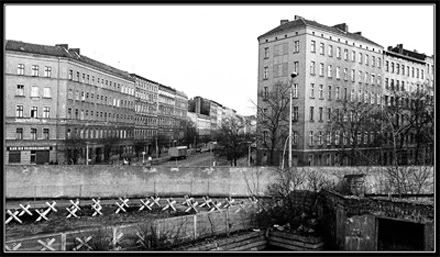
But mainly it seemed like a good place to go to detox and collect one's wits. Bleak, depressed, somewhat coldly (and dingily) modern, furtively wrestling with its own history in the most repressed of ways, physically divided, socially and politically adrift in the throes of its Cold War limbo. That was the impression of the place as it existed at the time, anyway – the picture that the word "Berlin" commonly painted in a person's mind. A "come-down" city if ever there was one. You wander down a given city street, only to come to its sudden and abrupt end, the point of stoppage at which you find yourself facing the Wall. Some histories aren't so easily left behind, some histories leave harsh reminders.
. . . . . . . . . . . . . . . . . . . .
3.
It was Christopher Isherwood who put the idea of moving to Berlin into Bowie's head. Bowie had long been a fan of Isherwood, whose Goodbye to Berlin had undergone a recent revival in popularity from loosely providing the inspiration for the musical Cabaret. Attending the Los Angeles stop of the Station to Station tour in 1976, Isherwood and artist David Hockney had made their way backstage to converse with the singer afterward. The topic of Berlin came up. Isherwood would later claim that he tried to disabuse Bowie of the notion of going there, going so far as to dismiss the city as "boring." No matter, as it prompted Bowie to decide that a lack of distractions and some anonymity were what he needed to clear his head, and it wasn't much later that he started packing his bags.
. . . . . . . . . . . . . . . . . . . .
4.
Bowie wasn't the only one fascinated by Berlin in the 1970s. Far from it. A quick survey of the American cultural landscape revealed that a certain number of people in the U.S. shared a similar interest. Lou Reed's Berlin LP might've played some small part in the matter, with the way it sketched its setting in the gloomiest and starkest of tones. And there was also the popularity of the Broadway and film productions of Cabaret. Plus, the novels of Heinrich Böll and Günter Grass sold modestly well, with the films of Herzog and Wertmüller and Fassbinder and Wenders drawing crowds at the cinema in New York and reviews from urbane film critics.
As far as how the idea of Berlin was conceived and held in the American public imagination -- it represented something, must've served as some kind of metaphor. But a metaphor for what? Nobody ever said precisely, and perhaps nobody actually knew. Something having to do with trauma and unthinkable sins, with atonement and the weight of history, about rebuilding from the wreckage without looking back, of not being able to speak of the past, of living in a historical limbo. And about modernity. Because Berlin seemed deeply modern, but in a way that was as hard-won and enburdened as any form of modernity could be.
Humble Pie were the stinkiest, skeeziest band of their era. Unlike peers such as Led Zeppelin, Deep Purple and Free, they had no ambitions toward spiritual uplift or magical enlightenment. Nor did they attempt to add symphonic grandeur or modernist edge to their sound. It was as though they had taken the most disreputable themes of the Rolling Stones as a base to build on, or, rather, tunnel down from. Lyrically they offered no expansive vistas, no deserts or mountains or streams, and no visions of progress or redemption. Humble Pie were an indoors band, and indoors meant either the bar or the coke den or the brothel.
What they did have was a killer groove, and a thick, soupy sound that unrolled like the smoky fug in a late-night bar. Even George Clinton would have needed to wear a gas mask when wading through the acrid hum of songs like "One-eyed Trouser Snake Rumba" or "Wrist Job". But like all truly great bands, they have that knack of convincing you, while you’re listening to them, that they’re the greatest band in the world. The best rock music is about a certain kind of precision-timed looseness, and in this respect, Humble Pie had found the Holy Grail. Their riffing ranged around the beat as though tied to it with elastic, giving their music a kind of immaculate swagger, a gold-toothed loucheness.
The band were formed in 1968 by the former Small Faces singer Steve Marriott, along with Herd guitarist Peter Frampton. The Gollum-esque Marriott was a notoriously bi-polar character. Known to friends and colleagues as a particularly generous and spontaneous individual with an impish sense of humour, in private he was consumed with doubt and envy of those he considered were unfairly more successful than him. Marriott even gave a name, "Melvin", to this grouchy, unattractive side to his personality, and his entire career was a battle between "Steve" and "Melvin" to see which one would eventually come out on top. It was this internal battle that no doubt gave his live performances their explosive intensity - in my opinion he was the most exciting front man of them all.
If The Small Faces are remembered for their moddish neatness and their insertion of a particularly English sensibility into psychedelia, then Humble Pie were the absolute opposite, a filthy immersion in Americana, and this is why so few admirers of the former band have any interest in the latter. Humble Pie began as a kind of super group, hoping to take the commercial success of The Small Faces onto the world stage, but after their first record company, Immediate, folded, they were picked up by American management and an American record company, and became, with their self-titled third album, a de facto American band. Based in the US, and with all their efforts made to crack that market, their manager Dee Anthony did whatever he could to limit their return to British soil in case it prompted them to become homesick.
It was also Anthony who encouraged them towards a funky, hard-rocking sound, and it was this coarsening that prompted the departure of Frampton in 1971, and his replacement by Clem Clempson, whose playing dovetailed perfectly with the palpitating rhythms of Greg Ridley and Jerry Shirley. By 1973’s "Eat It", the band had even picked up their own backing group, the Blackberries, made up of former Ikettes Venetta Fields, Clydie King and Sherlie Matthews, allowing them to plunge even deeper into the Southern Soul sound that had been their initial inspiration.
Humble Pie were a band who eventually died of exhaustion. By 1974, they had toured the USA non-stop for four years, and returned to Britain to find themselves not only physically shattered, but also penniless, their earnings eroded not only by their own indulgences, but by the familiar record company and management racketeering. After the band fell apart, the impulsive Marriott became suspicious of success, and the remainder of his career was spent in half-hearted attempts to rekindle former glories while consuming hefty amounts of drugs and alcohol and evading the taxman, who was still chasing him over royalties earned more than a decade before. Marriott was to die in a house fire in 1991, caused by him falling asleep in bed with a lit cigarette. His blood sample was found to contain traces of valium, alcohol and cocaine. A deeply tragic, though not entirely surprising end.