Showing posts with label U-W. Show all posts

Wednesday, 6 February 2013

My String Snapped

Enjoying a day out at the seaside
Siouxsie and The Banshees are generally classified as ‘Post Punk’, i.e. they didn’t release a record until 1978 and they were more subtle and cerebral than, say, UK Subs. Their music is distinctly ‘against’, but is cool and ironic and caustic, rather than simply angry and loud. In ‘Suburban Relapse’, a song from their aptly titled first LP ‘The Scream’, Siouxsie (formerly Susan Janet Ballion of Chislehurst, Kent) details her own potential nervous breakdown.


‘I'm sorry that I hit you but my string - snapped
 I'm sorry I disturbed your cat-nap
But whilst finishing a chore
I asked myself what for
Then - something – snapped’
There’s something horrible about that opening verse, especially its politeness and the banality of the phrase ‘cat-nap’. The violence of the situation is not in the physical attack, but in the twang of the snapping string. The words are perfectly complemented by the backing music, which sounds like sheets of metal being tipped over a cliff, and by Siouxie’s vocal, with its perfect balance of numbness and growing hysteria, full of the fuzzy, unpredictable threat of madness. She goes on to ask:
'Should I throw things at the neighbours?
Expose myself to strangers?
Kill myself or you?’

Rather a difficult question to answer.  

Not afraid
Although it’s hard to imagine the fearless Siouxsie Sioux in an apron, she nevertheless understood the underlying dread of the suburbs. Her father had died of cirrhosis of the liver when she was 14, and one can only imagine the pressure of growing up in a home where one of your parents is a chronic alcoholic. Not surprisingly, the thing that young Susan most wanted was to be like everybody else -
‘My family felt like the Addams Family, and I grew up desperately wanting to be normal. We stuck out - even our house was different from all the others on the street. It was this modern house, with a hedge in front that was so tall you couldn't see the house, and the neighbours complained’.
It’s the small details of that private hell that nag at you: the embarrassing overgrown garden, the neighbours ganging up on you, or, in another memory, the dolls pram with a bent wheel from when Daddy fell on it when he was drunk.
When her father died, Susan became dangerously ill with ulcerative colitis. As she recovered she saw David Bowie on the TV and realised that being like everybody else was over-rated. Her ‘race memory’, of the straitjacket of life in the suburbs, however, is a recurring theme in the band’s early work, and brilliantly exemplified here.
Unmann-Wittering.

Thursday, 6 October 2011

The Ballad Of Ruby Flipper


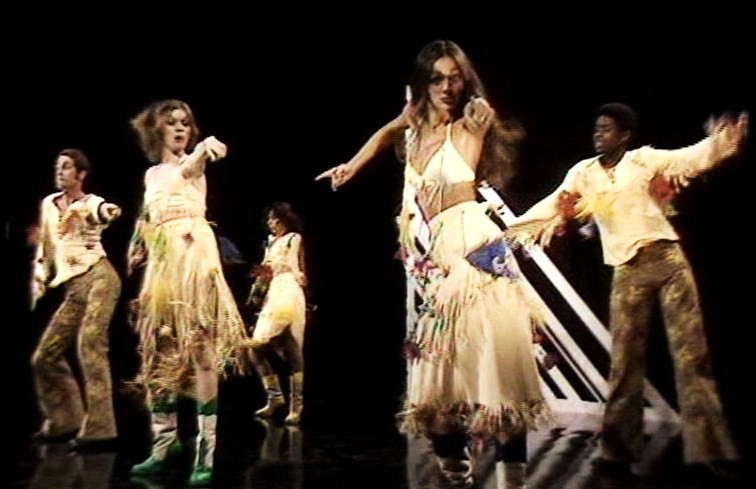
Those of you enjoying the current re-runs of every 1976 'Top Of The Pops' will almost certainly have noticed two things: that the charts have always been shit, and the inexplicable and occasionally mindscramblingly cryptic performances of mixed sex, interracial dance troupe Ruby Flipper.

The Flipper, as they have never been known, were only on the show for five months,and never managed to warm the nation's cockle and loins in the same way that their immediate predecessors, Pan's People, had done, despite featuring two former People in their line up. The precise reasons for this may never be known, although BBC Head of Light Entertainment Bill Cotton tried to put his finger on the problem in a meeting with legendary choreographer Flick Colby - 'Flick, no-one in England wants to see white girls dancing with a black man'. Cotton's most notorious programme was, of course, 'The Black & White Minstrel Show'.

Here are some select moments from their short reign of terror.

The Flipper were quite good at the disco stuff, but then, after all, disco is designed to dance to. What they were able to do on a number of occasions is to communicate the energy of the music to the traditionally rather lumpy studio audience, upping the tempo of their shuffling considerably. In this routine, they demonstrate the dual nature of Colby's routines - a confusing mix of lacivious grinding and infantile pantomime.


This routine is as much avant garde theatre as Thursday night pop variety, with a colour scheme pinched from a Czech New Wave film and a concept that has echoes of Dante Alighieri . It's baffling and frightening and the shaking, banging wrists are vaguely pornographic. In my nightmare, the song never ends, and I end up watching them walking in and out of these wobbly doors for all eternity.


Finally, here's their interpretation of Bowie's 'TVC15'. It always reminds me of a fly on the wall documentary set in a secure unit. I keep expecting R.D Laing to wander in with a clipboard. Bizarre, although I'm sure Dame Dave would have approved.


Ruby Flipper,
March 1976 - October 1976.

Unmann-Wittering.

Open Letter To The BBC

Dear Marmaduke Hussey,

I know you have to make a 20%  budget cut over the next five years, might I suggest the return of this old favourite?


It's better than 90% of your output, and little Carole Hersee and Bubbles are far more charismatic than 99% of your presenters.

Unmann-Wittering.

Sunday, 20 March 2011

Warning! Polarity Reversing


How precarious life in Britain was in the 1970’s. Without really knowing it, we were under attack from all angles, a relentless barrage of aggression that made the Blitz look like a disagreement over bric a brac at a jumble sale. As most of us went about our business (buying paraffin, listening to Slade records, going on strike, wearing massive trousers, smoking) our sceptered isle was a secret war zone, our lives and way of life threatened from under the sea, under the ground, from the future, from the distant past and from the farthest, coldest, darkest recesses of intergalactic space.

As a child, I would lay awake and wonder what would become of us if it wasn’t for Dr. Who. Exiled to Earth, he was the one thing that stopped us time and again from invasion, subjugation, annihilation - and he didn’t even really want to be here. Imagine the UK without the Doctor, and in short time we’d have been over-run by animated inanimate objects, held to ransom by aliens, taken over by an ancient race of reptiles, then ravaged by a savage war of conquest between those self-same reptiles and their ruthless aquatic cousins, mankind reduced to hapless observers, slaves, forgotten, impotent witnesses to the end of civilisation as we knew it.


Not surprisingly, I hero-worshipped the 900 year old alien responsible for keeping me alive and sought to pay him tribute by watching his struggles of a Saturday tea time, buying his chocolate and keeping the wrappers, eating his cereal, wearing his badges and, most of all, obsessively reading his annual reports which were published each year in time for Christmas.

There is no-one that has ever had as big an influence on me as the Third Doctor, including family members, which is not so much a reflection on them as an indicator of the sort of person I would grow up to be: fickle, and more interested in the imaginary and ephemeral than the here and now, the there and then, the mundane nuts, boring bolts and less than riveting rivets of real life. It’s desperately sad, of course, I know that but the pitiful nature of that revelation doesn’t negate its truth.


Dr. Who taught me that life is tentative, random, fragile: one minute you’re riding your bike to work, the next you’re being blown away by a dapper shop dummy. It also taught me that, as a species, we’re nowhere, not ancient, not adaptable, technologically backward, fatally vulnerable, helpless.

In a time when plastic flowers and sofas could, and did, kill, we needed a much older, far wiser head to watch our backs. I miss that. Precarious life might have been back then, but I felt safe, reassured. Now, I’m permanently on edge, and life is revealed as a game of cards on an oil rig, soon to be interrupted by a heat ray wielding terrapin with a wet vest and murder in mind.


Unmann-Wittering.

Thursday, 27 January 2011

Screaming In The Dark

When John Lennon experienced an existential crisis after The Beatles had broke up, he desperately cycled through a series of alternative therapies and philosophies before recording a self-indulgent LP and deciding that all belief systems were rubbish and retreating into the state of pampered egotism he felt most comfortable in.

When Oscar nominated lyricist and composer Dory Previn hit the same wall she poured it all into her music, culminating in a series of deeply idiosyncratic solo albums released between 1970 and 1976. Dory used these records to obsessively dissect where she had been and where she was going (her first solo LP of the decade was called ‘On The Way To Where…’), in the most coruscating and brutally self-critical terms, returning time and time again to key points in her angst ridden life. These recordings contain some of the most honest and searingly personal music ever pressed onto vinyl.  

The appeal of singer songwriters is often that their stuff is easy to relate to, i.e. the audience feel that elements of their own lives are being set to music and reflected back at them: after all, they’re going through their own changes, their own relationships, their own shit. But no-one had shit like Dory Previn. As a child she had suffered at the hands of her alcoholic shell-shocked father who once held her and her mother hostage at gun point for several months before disowning her as someone else’s kid and dying; a devout Catholic, she had been beaten and abused by the Nuns at her school for the crime of being left handed; a dedicated wife and musical partner to Andre Previn, the break up of their ten year marriage (hastened by Andre’s affair with Dory’s close friend Mia Farrow) triggered a complete nervous breakdown, a long stay in a mental hospital and gruelling electroconvulsive therapy.

Dory takes the confessional song and turns it into show trial, most often placing herself (or Mia bloody Farrow) in the dock. Dory doesn’t just use elements of real life in her material, she is her material, and her songs are occasionally shocking in how frank and unflinching they are. If this sounds self-indulgent then, yes, quite right: it’s supremely self-indulgent, but done without ego or appeals for sympathy and with wit and irony and great eloquence and intelligence. You feel that Dory would have written these songs anyway simply because she needed to write them, the fact that somebody paid her to record them is irrelevant.

If there can be a single song that sums up Dory Previn’s unique talent, its probably ’Twenty Mile Zone’. Based, of course, on a true story, it details how she was pulled over by a traffic cop who had seen her driving along on her own at night, screaming out of the open car window at the top of her lungs. The genius of the song is in its jaunty and amusing representation of what can only be the symptoms of mental illness, and the telling of the two sides of the story: the cop who doesn’t understand why Dory is screaming, and Dory’s incomprehension that more people aren’t.  


Unmann-Wittering.

Straight Time

‘Straight Time’ is a 1978 film directed by Ulu Grosbard which contains one of Dustin Hoffman’s finest and most uncompromising performances.


Hoffman is Max Dembo, a career criminal who has spent his life in and out of prison. After completing his latest sentence he briefly attempts to go straight, finding work in a can factory and a respectable new girlfriend, Jenny (a young Theresa Russell) but he is almost immediately compromised by an old friend and finds himself back inside on a trumped up parole violation. To his obvious disappointment, he is re-released after only a few days. Max is picked up by his obnoxious and draconian parole officer (M. Emmet Walsh, in an infinitely punchable role). On impulse, Max beats him up and leaves him semi-naked and handcuffed on the central reservation, then steals his car and goes back to his default position: crime.


Dembo is no master criminal, however, he’s a stick up artist, a ruthless and violent man who forcibly takes what he needs to stay alive, driven by expediency and the need to lash out at those who oppose him. His crimes are impulsive, reckless and improvised. He motivates himself by drawing on his rage at the injustice of his situation: his lowly place in the world outside of prison and his persecution by society, by his parole officer, by the manager of an upmarket jewellery store who treats him with condescension and suspicion as he’s out shopping with Jenny. As a sociopath, of course, he has no interest in how his own behaviour contributes to this (he is casing the joint, after all), not even as he robs the jewellery store and threatens the manager as a punishment for treating him like a criminal.

The jewellery store robbery and its aftermath is probably the key sequence in the film. This is no finely worked plan, no detailed, clock mechanism ‘Rififi’ type plot, it’s a haphazard smash and grab, a violent assault cooked up in a few hours over some beers with his accomplices Willy & Jerry (Gary Busey and Harry Dean Stanton). The raid goes wrong, of course, but not through lack of planning. Max, inexplicably, but quite deliberately, lingers too long at the scene, smashing case after case of jewellery when he and Jerry should be making their escape. As a result, spooked by the sound of sirens, getaway driver Willy panics and leaves the scene, leaving his accomplices to their fate.


A basic reading might be that Max simply gets greedy, or that his rage makes him careless. It could, of course, be suggested that Max wishes to get caught, or killed in the pursuit of the robbery: to reach the only destinations available to him (jail or death) immediately, to get somebody else to put an end to it once and for all. Within a few moments, however, his feral survival instinct kicks in and Max is running for his life, and it’s Jerry who pays the price for his friend’s death wish, dying ignobly in someone’s back yard.

Having only just escaped with his life and the loot, Max makes plans to leave town with Jenny, stopping only to kill Willy for his betrayal. Shortly afterwards, Max stops for fuel and, with a brief explanation ( "Why can't I go with you?" - "Because I'm gonna get caught"), leaves Jenny at the gas station and continues on his own, an act that could be interpreted as a gesture of noble self-sacrifice, but, more in keeping with his ruthless nature, also makes Max’s life as a fugitive infinitely simpler.


Early in the story, Max meets up with Jerry for the first time after his long jail term. Whilst Max was inside, Jerry has married and set up his own business and is living the straight life in a nice house in the suburbs. Once his wife is out of earshot, Jerry says something like ‘you’ve got to get me out of here, man, it’s driving me nuts!’. Just like Max, even when Jerry is given a choice he can’t help himself: it’s all he knows. 

The last things we see are a series of mug shots, retrospectively plotting Max’s criminal career back to his first arrest at the age of 12. It’s an unsettling, infinitely downbeat finale that reiterates that Max’s ultimate fate is preordained by his character flaws and the drastically limited choices he has as a result: a ‘straight’ life will always be beyond his grasp.   


Hoffman, at the spiky, perfectionist height of his 70’s superstardom, is excellent, retaining his usual gentle, awkward likeability on the surface but giving his character a hard, sharp, dark centre. Ostensibly passive, this is a man who is at his most dangerous when threatened, and who excels at backing himself into corners.

A sombre but fascinating film, ‘Straight Time’ was not a success on release, and a dispute between Hoffman and the studio led to it being withdrawn for several years. Unhappily, it is still not available to buy on DVD in the UK although, if you wish to emulate the outlaw spirit of Max Dembo, it can apparently be downloaded illegally at the sort of places that specialise in this type of crime.  


Unmann-Wittering.

Saturday, 18 December 2010

We need facts!


Interesting the amount of mileage they get out of the idea that even The Queen will have to complete a census form (I expect the Queen Mum filled it out with a betting shop pen) but then these were the days when the Royal Family still had a totemistic, cap touching appeal to the majority of the public who watched the telly.

I'd like to see the results of the work of the army with light blue satchels when it's finally made public but, sadly, I'll be dead. What I do know is that 2 year 11 month old Paul lived at 79 St Andrews Avenue, Colchester, Essex with his bricklayer father, Keith (25) and his factory worker mother, Vicky (23).

By Unmann-Wittering.

Sunday, 28 November 2010

Tethered Balls

Back in 1978, Dunlop had a vision. If we'd listened to them and installed twenty million of these fuckers on every green space in Britain we'd have a country free of obesity, heart disease, social exclusion, class distinctions, boredom, health clubs and kettling, instead of this mouldering shithole of unfairness, juddering bellies and ignorance.


Don't blame me, though, I've still got mine and I feel fit, classless and very popular indeed.

Unmann-Wittering.

Saturday, 20 November 2010

Not a dawn is greeted with a bird song

It's 1971, and Cliff Richard hasn't had a big hit for ages, despite trying to keep up with the hairy zeitgeist by releasing a series of singles that nibble at the edges of the counter culture. Eager to appear on 'Top Of The Pops' again he calls up Hank Marvin and secures 'Silvery Rain', a big song with a big message: indiscriminate use of pesticides is killing the countryside. It only reaches number 27 and the furry back bees are doomed.


Not content with being both ten years ahead of his time and five years out of date, Cliff is also road testing the 'thinking about every word whilst employing elaborate story telling hand gestures' performance style that would later reach a pinnacle with 'the young wear their freedom like cheap perfume' line from 'Carrie Doesn't Live Here Anymore'.

Unmann-Wittering.

Friday, 19 November 2010

When the cussing has to stop

Help me, for I have become obsessed with 'Indoor League'.

Everything about the show mesmerises me: the fear behind Fred Trueman's oh so casual introductions, the Quaker Oats coloured faces, the Dickensian names, the couldn't care less hair, the relentless Yorkshire-ness, the fat beer glasses, dense knits and thick lenses, the intense concentration.

This is serious stuff, with cash prizes, which may be why everyone gives these pub pursuits the gravitas of the Heraclean games, insisting that they require superhuman skill and a degree in physics. Listen to the darts commentary with its emphasis on the uncanny, otherworldly accuracy / sheer monotony of two fairly average darts players as they take an eon to get down from 501, and the commentator's odd obsession with the physique of contender Colin Minton ("he's a heavy boy...").

So, here's a long clip, but one that deserves to be watched in its entirety. It tells you more about Northern life in the seventies than any sociological study, and more about table football than you thought there was to know.

If you're wondering about the dart board, it is, of course, a Yorkshire dartboard - no nonsense, no trebles and no bullshit outer bull. I'll see thee...

Unmann-Wittering.