Showing posts with label TV. Show all posts

Thursday, 3 November 2011

Please Stand By, Pt. 2 - An Inventory of Effects


1.

Here we have the American artist Chris Burden, looking like a professional and presenting himself to the world. The above photos come from his 1971 performance art piece I Became a Secret Hippy. It was one of Burden's earliest works, executed about the time he was completing his graduate studies at the University of California, Irvine. For the piece, Burden stripped naked and laid down on the floor while a friend hammered a star-shaped stud into his chest. He then sat in a chair while another friend shaved his head with electric shears. Burden then donned the suit of an FBI agent and presented himself to the event's few attendees.

The real-world incidents that inspired I Became a Secret Hippy are so obvious that they don't warrant an explanation. In that respect, it was far from being a subtle work. But considering that it was done at the time that Burden was leaving the cloistered confines of academia and making his transition into the world of professional artmaking, no doubt its ritualistic, rite-of-passage mimicry held some ironic personal meaning for the artist.


. . . . . . . . . . . . . . . . . . . .


2.

By many accounts, the early Seventies were considered turbulent years -- a time of political, social, and economic upheaval. Most Americans had entered the 1960s with an optimistic vision of the future that awaited them. But a decade later, it all looked uncertain and many people were getting anxious and doubtful, not daring to guess what might happen next. A common, knee-jerk opinion on the street had it that the world was going to hell. "Shootin' rockets to the moon / Kids growing up too soon… Ball of confusion!"

Soldiers returning home after numerous tours of Vietnam reputedly experienced something akin to culture shock, finding things at home much different from when they'd departed. The rapid pace of technological change, and the societal shifts that resulted, had some in the pop-sociology realm talking of "future shock."

So when people read that somewhere a young man had someone shoot him with a rifle and then called the whole thing art, a number of people were shocked, but probably not all that surprised. This is what passes for art these days. The way things were heading, why not?


. . . . . . . . . . . . . . . . . . . .


3.

The incident in question -- the one that would become Burden's notorious "greatest hit" -- was Shoot, which followed I Became a Secret Hippy by a mere three weeks. On the evening of November 19, 1971, Burden and a few associates and a small number of attendees met in a low-rent art space in Santa Ana. It was, by most accounts, a pretty modest and casual affair, up to the point when -- at an "Okay, let's do this" moment in the evening -- Burden positioned himself against one of the gallery walls. A friend then raised a .22-calibre rifle, took aim at Burden, and fired a single shot.

The plan was a have a handful of spectators witness a William Tell-styled act of trust, with the designated shooter aiming at the wall just to the left of Burden's shoulder. At the most, Burden later claimed, the rifle slug was only supposed to graze him. But due to poor marksmanship the bullet instead hit Burden in the bicep of his left arm. Not having anticipating such an outcome, no one had thought to bring a first-aid kit, so a bandage had to be improvised.


. . . . . . . . . . . . . . . . . . . .


4.

Before we go any further, a brief overview might be in order...

Selected Works, 1971 - 1976

Chris crams himself into a small metal locker for five days.
Chris gets shot.
Chris lies in a bed for 22 days.
Chris lies down under a tarp in traffic along a busy boulevard.
Chris nearly immolates himself.
Chris dangles naked tied by a rope around his ankles.
Chris crawls over broken glass.
Chris pushes live electrical wires into his bare chest.
Chris has people use him as a human pin cushion.
Chris runs the risk of immolating himself again.
Chris gets crucified to a Volkswagen.
Chris nearly drowns himself.
Chris gets kicked down two flights of stairs.
Chris nearly sets himself on fire. (Yes, again.)
Chris lies on a shelf, just out of sight, for 22 days.
Chris lies, unmoving, under a sheet of glass for 45 hours straight.
Chris bicycles through Death Valley.

Chris does a bunch of other things during these years, but it's the more violent and alarming and supposedly masochistic things he does that everyone talks about. Thereby making him a bit infamous in the process, saddling him a reputation as the "Evel Knievel of the art world" that he grew to resent.


. . . . . . . . . . . . . . . . . . . .


5.

Chris Burden didn't consider himself a "performance artist," nor did he ever aspire to be one. He'd originally set out to be a sculptor. In the latter years of his studies, he became preoccupied with the task of creating interactive sculptures -- works that invited the audience to become a part of the piece, that were meant to be engaged and manipulated by the viewer. But he quickly became frustrated and deemed many of his works to be unsuccessful, because each time the audience balked at the invitation, choosing instead to maintain the role of distant and passive spectators.

To remedy this impasse, Burden decided to physically make himself a part of the "sculpture," if not the primary component of the work itself. He did this for his senior thesis project, which involved cramming himself into a 2' x 2' x 3' steel locker for the duration of five days. As word of the Burden's project circulated around campus, the curiosity factor brought a steady flow of visitors. People sat outside the locker, inquiring into his well-being and asking him why he was doing what he was doing. A few people sat for extended periods and -- perhaps confused by the dynamic -- treated him like a Father Confessor and divulged all sorts of personal details about themselves. During the final day of the piece, university administration were debating whether to have the locker cut open, fearing for their own liability in connection with Burden's project.

So, problem solved. But noted for future reference: How to calculate for the vagaries of interpersonal psychology? 1


. . . . . . . . . . . . . . . . . . . .


6.

Performance art was, of course, something of a big deal in the artworld of the 1970s, and Chris Burden was regarded as one of its leading and most controversial pioneers. But performance art wasn't such an entirely new thing. It'd first been kicked around by the Futurists and the Dadaists in the early part of the century, then gone dormant for many years before being reanimated in the 1950s and 1960s, primarily by way of the "happenings" staged by John Cage and his disciples in the Fluxus movement.

If there was any recent historical precedence for the type of work Chris Burden was executing in the early '70s, it was probably Yoko Ono's 1962 Cut Piece, which involved the artist sitting silently on a stage and inviting the audience to cut of here clothing piece by piece with a pair of communal scissors. On the three occasions that Ono staged Cut Piece during the mid-1960s, the audience obliged her each time, in the end leaving the artist sitting on stage wearing little more than scraps and tatters.

Cut Piece is an often-cited work in its own right. Critics often speak of how the piece addresses gender dynamics and how these dynamics play out in terms of social power and status. But in a broader context, one could argue that it ultimately points to an interrogation of the codes of conduct in a supposedly polite society, one which eventually (or hopefully) leads to a critique of the nature of socialization itself. 2


. . . . . . . . . . . . . . . . . . . .


7.

On the morning of January 5, 1973, Chris Burden walked out onto a beach near the runways of LAX and fired several shots from a revolver at a 747 as it flew overheard. Burden later explained that the piece was about "impotence," since he knew in advance that the bullets would fall short of their target. Impotence in this case meaning bold but futile gestures, the inadequacy of human agency in the face of the grander scheme of things.

Still, unsurprising to learn that the FBI showed up on his doorstep with some questions about the incident a few days afterwards.

. . . . . . . . . . . . . . . . . . . .

Thursday, 6 October 2011

The Ballad Of Ruby Flipper


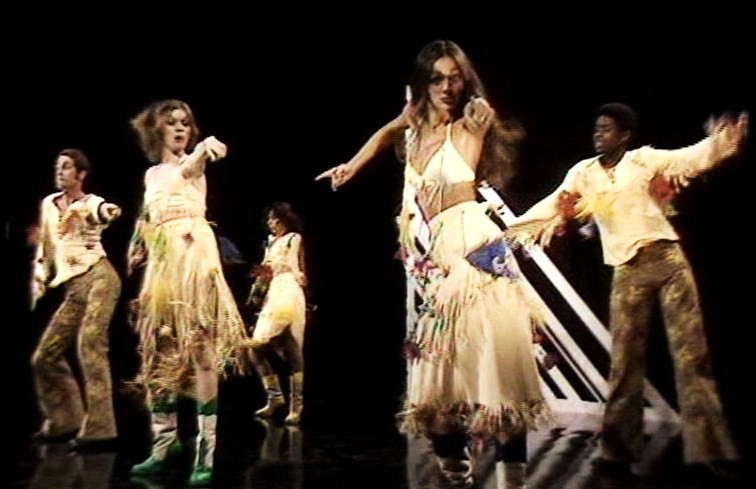
Those of you enjoying the current re-runs of every 1976 'Top Of The Pops' will almost certainly have noticed two things: that the charts have always been shit, and the inexplicable and occasionally mindscramblingly cryptic performances of mixed sex, interracial dance troupe Ruby Flipper.

The Flipper, as they have never been known, were only on the show for five months,and never managed to warm the nation's cockle and loins in the same way that their immediate predecessors, Pan's People, had done, despite featuring two former People in their line up. The precise reasons for this may never be known, although BBC Head of Light Entertainment Bill Cotton tried to put his finger on the problem in a meeting with legendary choreographer Flick Colby - 'Flick, no-one in England wants to see white girls dancing with a black man'. Cotton's most notorious programme was, of course, 'The Black & White Minstrel Show'.

Here are some select moments from their short reign of terror.

The Flipper were quite good at the disco stuff, but then, after all, disco is designed to dance to. What they were able to do on a number of occasions is to communicate the energy of the music to the traditionally rather lumpy studio audience, upping the tempo of their shuffling considerably. In this routine, they demonstrate the dual nature of Colby's routines - a confusing mix of lacivious grinding and infantile pantomime.


This routine is as much avant garde theatre as Thursday night pop variety, with a colour scheme pinched from a Czech New Wave film and a concept that has echoes of Dante Alighieri . It's baffling and frightening and the shaking, banging wrists are vaguely pornographic. In my nightmare, the song never ends, and I end up watching them walking in and out of these wobbly doors for all eternity.


Finally, here's their interpretation of Bowie's 'TVC15'. It always reminds me of a fly on the wall documentary set in a secure unit. I keep expecting R.D Laing to wander in with a clipboard. Bizarre, although I'm sure Dame Dave would have approved.


Ruby Flipper,
March 1976 - October 1976.

Unmann-Wittering.

Open Letter To The BBC

Dear Marmaduke Hussey,

I know you have to make a 20%  budget cut over the next five years, might I suggest the return of this old favourite?


It's better than 90% of your output, and little Carole Hersee and Bubbles are far more charismatic than 99% of your presenters.

Unmann-Wittering.

Sunday, 10 April 2011

The Audience Comes First


"As an experiment in social history, it would be worth compiling a video of the 'Top of the Pops' audiences of that period, containing no shots of the bands. Here, in the nervous jigging-about of puppy fat, bum fluff, and denim waistcoats, you will see Ziggy's children, awkwardly trying to come to terms with a pop spirit that must have seemed audacious to the point of unbelievable."
- Michael Bracewell, When Surface Was Depth


"Here was a group who looked as though they came from not only another era -- the 1950s as they might be reconstructed in the twenty-first century -- but also from another planet. ... Brian Eno, had claimed with straight-faced passivity that he was a visitor from the planet Xenon. But having a bona fide alien in the band seemed almost less outrageous than the unholy barrage of nerve-jarring electronics squeals and furiously accelerated piano chords that the group were pumping out. [...]

And then there was Bryan Ferry's extraordinary vocal style, in which breathless staccato phrasing gave way to something between a fox's bark and the leering self-preening of a high-camp crooner in the throes of amphetamine psychosis. But by the time that he had reached the pivotal break in the song -- 'We are flying down to Ree-Ohh' -- the bewildered [TOTP] studio audience of youthfully plump young people had ceased their customary expressionless jigging up and down, and were trying to work out just what manner of adult pop freakishness had crash-landed into their hitherto teenage world of Marc Bolan's glam pout and Donny Osmond's puppy love.

'If Roxy Music had been like cooking,' says Andy MacKay,...'It would be like the dish in Marinetti's Futurist cookbook called Car Crash: an hemisphere of puréed dates and an hemisphere of puréed anchovies, which are then stuck together in a ball and served in a pool of raspberry juice. I mean -- it's virtually inedible, but it can be done.'"
- Ibid.
* * * * * * * * * * *


A few random thoughts about the above...


  1. As far as that first bit is concerned, it's a great idea. But if anyone's ever compiled such a thing, I've yet to come across it. So this one'll have to do as a substitute.
  2. Hailing from the Stateside shores of the big water, there's a lot about the U.K. mediascape that I can't quite get my head around. Case in point: The institutional or integral importance that shows like TOTP or The Old Grey Whistle Test might (or might not have) had once upon a time. In the 1970s, there wasn't anything in the U.S. that served as any sort of equivalent. Sure, there were roughly similar things like American Bandstand and Soul Train and Don Kirshner's Rock Concert; which featured artists in varying degrees, but they were usually shuffled into odd and marginal time-slots. As far as primetime was concerned, it was mostly variety shows -- meaning that a guest slot by someone like The Bay City Rollers, Rod Stewart, or the Bee Gees was about as riotous as it was likely to get.
  3. As far as the second item is concerned: Yes, I guess there is no accounting for -- this many years after the fact -- just how strange and confusing this must've seemed in its original in situ context. Quite frankly, it took me a while (years, in fact) to process the early Roxy material -- to fully absorb and appreciate it for all its baffling incongruencies and eclecticism.
  4. And yes, Roxy's influence on later artists was immense and widely acknowledged; although it often seems like said influence was usually drawn from the most cosmetic elements of the group's music and image. But as far as "Virginia Plain" is concerned, I've always felt that it served as the one-shot stylistic template for the bulk of these guys' output. Remake/remodel, indeed.

Sunday, 20 March 2011

Warning! Polarity Reversing


How precarious life in Britain was in the 1970’s. Without really knowing it, we were under attack from all angles, a relentless barrage of aggression that made the Blitz look like a disagreement over bric a brac at a jumble sale. As most of us went about our business (buying paraffin, listening to Slade records, going on strike, wearing massive trousers, smoking) our sceptered isle was a secret war zone, our lives and way of life threatened from under the sea, under the ground, from the future, from the distant past and from the farthest, coldest, darkest recesses of intergalactic space.

As a child, I would lay awake and wonder what would become of us if it wasn’t for Dr. Who. Exiled to Earth, he was the one thing that stopped us time and again from invasion, subjugation, annihilation - and he didn’t even really want to be here. Imagine the UK without the Doctor, and in short time we’d have been over-run by animated inanimate objects, held to ransom by aliens, taken over by an ancient race of reptiles, then ravaged by a savage war of conquest between those self-same reptiles and their ruthless aquatic cousins, mankind reduced to hapless observers, slaves, forgotten, impotent witnesses to the end of civilisation as we knew it.


Not surprisingly, I hero-worshipped the 900 year old alien responsible for keeping me alive and sought to pay him tribute by watching his struggles of a Saturday tea time, buying his chocolate and keeping the wrappers, eating his cereal, wearing his badges and, most of all, obsessively reading his annual reports which were published each year in time for Christmas.

There is no-one that has ever had as big an influence on me as the Third Doctor, including family members, which is not so much a reflection on them as an indicator of the sort of person I would grow up to be: fickle, and more interested in the imaginary and ephemeral than the here and now, the there and then, the mundane nuts, boring bolts and less than riveting rivets of real life. It’s desperately sad, of course, I know that but the pitiful nature of that revelation doesn’t negate its truth.


Dr. Who taught me that life is tentative, random, fragile: one minute you’re riding your bike to work, the next you’re being blown away by a dapper shop dummy. It also taught me that, as a species, we’re nowhere, not ancient, not adaptable, technologically backward, fatally vulnerable, helpless.

In a time when plastic flowers and sofas could, and did, kill, we needed a much older, far wiser head to watch our backs. I miss that. Precarious life might have been back then, but I felt safe, reassured. Now, I’m permanently on edge, and life is revealed as a game of cards on an oil rig, soon to be interrupted by a heat ray wielding terrapin with a wet vest and murder in mind.


Unmann-Wittering.

Tuesday, 18 January 2011

We Want the Airwaves


Neilsen Ratings: Top Ten U.S. Television Shows, 1979-1980

1. 60 Minutes
2. Three's Company
3. M*A*S*H
4. Alice
5. Dallas
6. Flo
7. The Jeffersons
8. The Dukes of Hazzard
9. That's Incredible
10 One Day At A Time

Friday, 19 November 2010

When the cussing has to stop

Help me, for I have become obsessed with 'Indoor League'.

Everything about the show mesmerises me: the fear behind Fred Trueman's oh so casual introductions, the Quaker Oats coloured faces, the Dickensian names, the couldn't care less hair, the relentless Yorkshire-ness, the fat beer glasses, dense knits and thick lenses, the intense concentration.

This is serious stuff, with cash prizes, which may be why everyone gives these pub pursuits the gravitas of the Heraclean games, insisting that they require superhuman skill and a degree in physics. Listen to the darts commentary with its emphasis on the uncanny, otherworldly accuracy / sheer monotony of two fairly average darts players as they take an eon to get down from 501, and the commentator's odd obsession with the physique of contender Colin Minton ("he's a heavy boy...").

So, here's a long clip, but one that deserves to be watched in its entirety. It tells you more about Northern life in the seventies than any sociological study, and more about table football than you thought there was to know.

If you're wondering about the dart board, it is, of course, a Yorkshire dartboard - no nonsense, no trebles and no bullshit outer bull. I'll see thee...

Unmann-Wittering.